
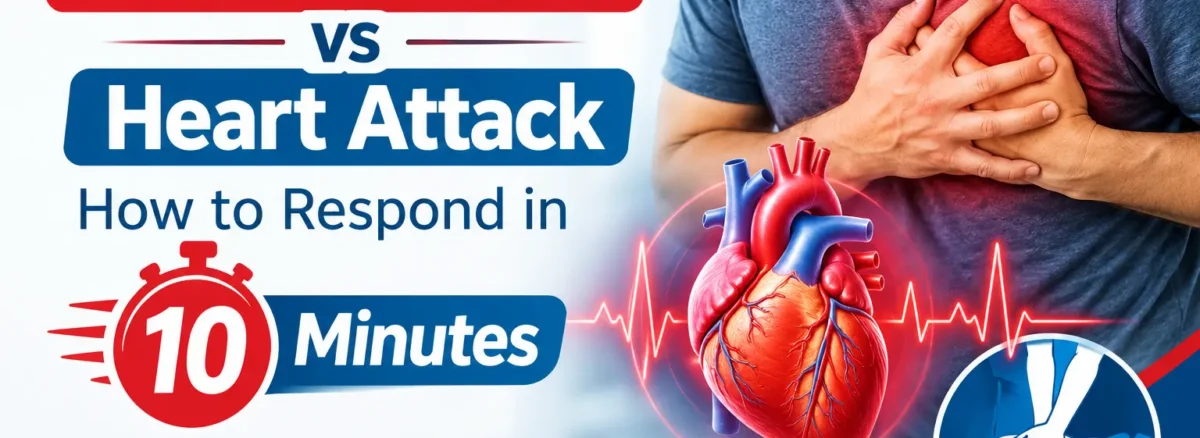
A heart attack is a blockage problem — blood cannot reach part of the heart muscle, and the person is usually awake and in pain. A cardiac arrest is an electrical problem — the heart stops pumping altogether, and the person collapses, stops responding and stops breathing normally within seconds. A heart attack can trigger a cardiac arrest, but they need completely different responses from a bystander. In cardiac arrest you start chest compressions immediately. In a heart attack you keep the person still, calm and get them to hospital fast.

Getting this wrong costs lives. The most common bystander mistake in India is treating a collapsed, unresponsive person as though they have fainted — splashing water, slapping cheeks, propping them up, pouring water into the mouth — while the minutes in which compressions would have worked run out.
What is the difference between a heart attack and cardiac arrest?
| Heart attack | Cardiac arrest | |
|---|---|---|
| The problem | Plumbing — a blocked coronary artery | Electrical — the heart’s rhythm fails |
| Onset | Often gradual; warning symptoms may build over hours or days | Sudden, usually without warning |
| Consciousness | Awake and talking | Unresponsive within seconds |
| Breathing | Breathing, sometimes breathless | Not breathing, or gasping noisily |
| Pulse | Present | Absent |
| What you do | Call for help, keep them still, get to hospital | Call for help and start chest compressions now |
| Time window | Minutes to a couple of hours to restore blood flow | Survival falls with every minute without compressions |
One more distinction worth knowing: fainting. Someone who faints goes pale, drops, and within seconds is breathing and responding again. Someone in cardiac arrest does not come back. If shouting and shaking produces no response and breathing is absent or just gasping, treat it as cardiac arrest.
How do you recognise a cardiac arrest?
Three things, checked in about ten seconds:
- No response when you shout their name and shake their shoulders firmly.
- No normal breathing. Look at the chest for five to ten seconds.
- Collapse without warning, often mid-activity.
The one that catches people out is agonal gasping — irregular, noisy, fish-out-of-water breaths that can continue for a minute or two after the heart stops. It looks like breathing. It is not. If someone is unresponsive and gasping like this, begin compressions.
How do you perform hands-only CPR?
If you are not trained, do compressions only. No mouth-to-mouth. This follows American Heart Association guidance on CPR for bystanders who witness an adult collapse. Compression-only CPR by an untrained bystander saves lives, and the fear of doing it wrong keeps far more people from acting than any harm CPR causes.
Step 1 — Check. Shout and shake the shoulders. Look for normal breathing for no more than ten seconds.
Step 2 — Call. Dial 108 for an ambulance or 112. Put the phone on speaker beside you so you can keep your hands free. Shout for anyone nearby to find an AED. Do not leave the person to go looking yourself.
Step 3 — Position. Lay them flat on their back on a firm surface — the floor, not a mattress or sofa. Kneel beside the chest.
Step 4 — Push. Place the heel of one hand on the centre of the chest, on the lower half of the breastbone. Put your other hand on top and interlock your fingers. Keep your arms straight and your shoulders directly above your hands, and push using your body weight, not your arms.
- Depth: 5 to 6 cm in an adult — deeper than most people expect
- Rate: 100 to 120 compressions per minute
- Let the chest come all the way back up between compressions
- Do not stop except to swap with someone else
Step 5 — Keep going until the ambulance team takes over, an AED is attached and tells you to stand clear, or the person starts breathing normally and responding.
For rhythm, the beat of Stayin’ Alive is the classic reference at around 103 beats per minute — the AHA’s hands-only CPR resources include a whole playlist in the 100–120 range. So is the Hindi film song Bhaag Milkha Bhaag title track — use whatever you can hold in your head.
CPR is physically exhausting. Quality drops noticeably after about two minutes, so swap with another bystander every two minutes if you can, taking no more than five seconds to change over.
What is an AED and how do you use one?
An automated external defibrillator delivers a controlled shock to restart a normal rhythm. They are increasingly found in airports, larger malls, corporate offices and some public buildings.
They are built to be used by untrained people. Switch it on and follow the spoken instructions. Stick the pads on bare skin exactly as pictured — one below the right collarbone, one on the left side below the armpit. The machine analyses the rhythm itself and will only allow a shock if one is needed, so you cannot shock someone who does not need it. Make sure nobody is touching the person when it says to stand clear, then resume compressions immediately after the shock.
Do not delay compressions while hunting for an AED. Compressions first, always.
What should you do if someone is having a heart attack but is still conscious?
Completely different response.
Sit them down and keep them still — half-sitting, leaning back, knees bent is usually the most comfortable. Do not let them walk around.
Call an ambulance. Our emergency line is (+91) 8822669275 and free ambulance service covers Guwahati 24×7. An ambulance is safer than a private car because treatment can start on the way and the hospital is alerted before you arrive.
Loosen tight clothing and keep the surroundings calm and ventilated.
Aspirin — if the person is conscious, able to swallow, and has no known allergy to it, chewing a dispersible aspirin can help. Chew, do not swallow whole. If you are unsure about allergy or bleeding risk, wait for medical advice.
Do not give water, food or a home remedy. Do not let them drive themselves.
If they collapse and stop responding, start compressions. That is the moment a heart attack has become a cardiac arrest.
The warning signs of a heart attack are not always the dramatic chest-clutching of films. Central chest pressure or tightness is the classic, but pain may spread to the jaw, neck, left arm or back, and may come with sweating, nausea, breathlessness or sudden exhaustion. Women, people with diabetes and elderly patients often present without significant chest pain at all. We cover this in more detail in chest pain: causes, diagnosis and treatment and heart attack symptoms, causes and treatment.
What are the mistakes bystanders most often make?
- Waiting to see if it passes. The commonest and costliest.
- Splashing water on the face or pouring water into the mouth of an unconscious person. This can go into the lungs.
- Slapping, shaking violently, or trying to make them sit up.
- Driving to hospital instead of calling an ambulance, then getting stuck in traffic with no equipment.
- Being afraid of breaking a rib. Rib fractures happen during effective CPR. They heal. Cardiac arrest without CPR does not.
- Stopping compressions too soon because the person made a noise or moved slightly.
- Doing nothing because you are not trained. Hands-only CPR requires no training. Doing something imperfectly is dramatically better than doing nothing.
Why is sudden cardiac arrest being seen in younger adults?
Cardiac arrest in someone in their thirties is uncommon but not unheard of, and it draws attention when it happens during exercise or at a gym. The usual causes are undiagnosed structural heart disease such as hypertrophic cardiomyopathy, inherited rhythm disorders, undetected coronary disease in people with a strong family history, myocarditis following a viral illness, and stimulant or steroid misuse.
If you have fainted during exertion, had unexplained palpitations, or have a first-degree relative who died suddenly and young, get a cardiac assessment before starting intensive training. It is a short set of tests — ECG, echocardiogram, sometimes a treadmill test — through our cardiology department.
Frequently asked questions
Can a heart attack cause cardiac arrest? Yes. A heart attack damages heart muscle and can destabilise the electrical rhythm, triggering cardiac arrest. This is why anyone with suspected heart attack symptoms should reach hospital quickly rather than waiting at home.
How deep should CPR compressions be? About 5 to 6 cm in an adult, at a rate of 100 to 120 per minute, allowing the chest to recoil fully between compressions. Most untrained rescuers push too softly and too slowly.
Should I give mouth-to-mouth or only chest compressions? If you are untrained, compressions only. Hands-only CPR is effective for adult cardiac arrest and removes the hesitation that stops people acting. Trained rescuers may add rescue breaths at 30 compressions to 2 breaths.
Can CPR restart the heart on its own? Rarely. CPR keeps oxygenated blood moving to the brain and heart, buying time until a defibrillator or medical team arrives. That is why calling for help and starting compressions must happen together.
What is the golden hour in a heart attack? The period soon after symptoms begin when restoring blood flow prevents the most heart muscle damage. The sooner treatment starts, the more muscle is saved — which is why reaching a hospital with cardiac facilities quickly matters more than which hospital is nearest to home.
Is it safe to do CPR on someone who does not need it? Doing compressions on someone whose heart has not stopped is very unlikely to cause serious harm, and they will usually respond and push you away. The far greater risk is not starting on someone who does need it.
In a cardiac emergency, call (+91) 8822669275. Free 24×7 ambulance across Guwahati, with emergency, ICU and HDU support on site at Hengrabari Road, Ganeshguri.
To assess your own heart risk, book a cardiology consultation. No online payment is required.
This article is general information and is not a substitute for accredited CPR training or medical care.
