
- September 25, 2026
- Editorial Team
- Comment: 0
- Blog
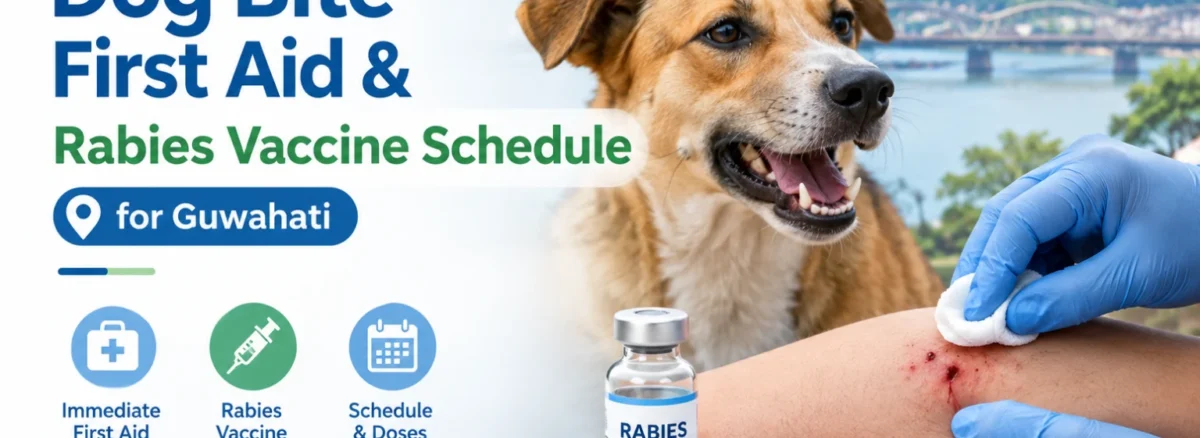
Dog Bite First Aid and Rabies Vaccine Schedule for Guwahati
If you have just been bitten, do this now: wash the wound under running water with soap for a full 15 minutes, do not cover it tightly, and get to a hospital for anti-rabies vaccine the same day. Washing properly is not a formality — it physically removes virus from the wound and is one of the most effective single steps in preventing rabies. Then read the rest of this page while you travel.
Rabies is almost always fatal once symptoms begin. It is also almost entirely preventable if treatment starts promptly — the WHO rabies fact sheet is unambiguous that prompt post-exposure treatment stops the virus reaching the nervous system. India still records a substantial share of the world’s rabies deaths, and the overwhelming majority follow dog bites where treatment was delayed, incomplete, or skipped because the wound looked minor.
What should you do in the first 15 minutes after a dog bite?
1. Wash, and keep washing. Running tap water and any ordinary soap, directly into the wound, for 15 minutes by the clock. Most people stop after 30 seconds. Do not. If the bite is on a limb, hold it under the tap. This single step substantially reduces risk.
2. Apply an antiseptic such as povidone-iodine or an alcohol-based solution after washing.
3. Leave the wound open. Do not bandage it tightly and do not let anyone stitch it immediately unless a doctor decides it is necessary — closing a contaminated wound traps virus inside. If bleeding is heavy, press gently with a clean cloth and get to hospital.
4. Do not apply anything traditional. Turmeric, chilli powder, lime, kerosene, oil, ash, herbal paste, chewed leaves. These are still used across Assam and they do real harm — they cause chemical burns, they introduce infection, and most dangerously they create the impression that something has been done.
5. Reach a hospital the same day. Ideally within a few hours, and certainly within 24 hours.
6. Note what you can about the animal — stray or pet, vaccinated or not, its behaviour, and where it was. Do not chase it or try to catch it.
What are the dog bite categories and what does each one need?
Doctors classify exposures into three categories, and the category decides the treatment. This is the table to look at.
| Category | What happened | What is needed |
|---|---|---|
| Category I | Touching or feeding an animal; licks on intact, unbroken skin | Wash the area. No vaccine required. |
| Category II | Nibbling of uncovered skin; minor scratches or abrasions without bleeding | Wound washing + anti-rabies vaccine |
| Category III | Single or multiple bites that break the skin; scratches that bleed; licks on broken skin or on the eyes, mouth or nose; any contact with a bat | Wound washing + anti-rabies vaccine + rabies immunoglobulin (RIG) |
Two points families regularly get wrong. A scratch that draws even a trace of blood is Category III, not II. And any bite on the face, head, neck, hands or genitals is treated with particular urgency, because nerves there are dense and close to the brain.
What is the anti-rabies vaccine schedule?
Two routes are used in India, both consistent with CDC post-exposure prophylaxis guidance and WHO recommendations. Your treating doctor decides which, based on the hospital’s protocol and the vaccine available.
| Regimen | Route | Days |
|---|---|---|
| Essen (intramuscular) | One dose in the upper arm muscle | Day 0, 3, 7, 14, 28 |
| Updated Thai Red Cross (intradermal) | Two small doses into the skin at each visit | Day 0, 3, 7, 28 |
Day 0 is the day you receive the first dose, not the day you were bitten. Every later date counts from that first injection.
Vaccine is given in the upper arm (deltoid) in adults and older children, and in the outer thigh in infants. It is never given in the buttock — absorption there is unreliable.
If you have previously completed a full rabies vaccination course, you do not repeat the whole schedule. You need only two booster doses, on day 0 and day 3, and no immunoglobulin. Tell the doctor about any past course.
When is rabies immunoglobulin needed?
Rabies immunoglobulin, or RIG, is given for Category III exposures in anyone not previously vaccinated. It provides ready-made antibodies that work immediately, covering the ten to fourteen days before the vaccine produces its own protection.
Per WHO guidance on rabies vaccination and immunoglobulin, as much of the dose as anatomically possible is infiltrated directly into and around the wound. This local infiltration is the part that matters most, so it must be done by someone trained. RIG should be given on day 0 alongside the first vaccine dose. If it was not available that day, it can still be given up to day 7 of the vaccine course — after that the vaccine response is already building and RIG can interfere with it.
RIG is not always available at every clinic, which is a practical reason to go straight to a hospital with a full emergency department rather than a small local facility. Our accident and emergency unit runs 24×7 with an on-site 24-hour pharmacy.
Do you also need a tetanus injection?
Often, yes. Dog bites are contaminated wounds and tetanus protection needs to be current. If your last tetanus dose was more than five years ago, or you do not know, expect a booster. The doctor will decide.
Antibiotics are prescribed for many bites, particularly deep punctures, bites on the hand, crush injuries, and in people with diabetes or reduced immunity. Do not start them yourself.
What about cat, monkey, bat and cattle bites?
Rabies is not a dog-only disease.
Cats transmit rabies and cat scratches are treated by the same category system. Cat bites on the hand carry a high infection risk and often need antibiotics.
Monkeys are a real exposure risk in parts of Assam, including around temples and roadside stops. Treat a monkey bite exactly as you would a dog bite.
Bats are the highest-risk category. Any bat contact — including waking to find a bat in the room, even without a visible bite — is treated as Category III, because bat bites can be too small to see.
Cattle, goats, pigs, horses and monkeys can all carry rabies. So can a mongoose or a jackal.
Rodents — rats, mice, squirrels — and rabbits very rarely transmit rabies, but bites still need cleaning and a tetanus review.
What if you miss a dose?
Take it as soon as you remember and continue the remaining doses counted from that point. Do not restart the course, and do not abandon it because you missed a date. Go back to the hospital where you started so your record is complete, and tell them what you missed.
The most common reason courses are abandoned is that the wound healed and the person felt fine. Rabies has an incubation period that is typically one to three months and can be much longer. Feeling well proves nothing.
When is a dog bite an emergency?
Go to hospital immediately, not to a clinic, if:
- The bite is on the face, head, neck, hands or genitals
- There are multiple or deep wounds, or bleeding that will not stop
- The victim is a child, an elderly person, or someone with diabetes or reduced immunity
- The animal was a stray, was behaving strangely, or was foaming at the mouth
- The wound becomes red, swollen, hot or starts discharging in the days after
- Any bat contact
Call (+91) 8822669275 — our emergency line is staffed 24×7 and free ambulance service is available across Guwahati.
Frequently asked questions
How soon after a dog bite should I take the vaccine?
As soon as possible, ideally the same day and within 24 hours. There is no cut-off after which it is pointless — if days or weeks have passed and no symptoms have appeared, start the course immediately. Late treatment is far better than none.
How many rabies injections are needed?
Five doses on days 0, 3, 7, 14 and 28 with the intramuscular Essen regimen, or four visits on days 0, 3, 7 and 28 with the intradermal regimen. Anyone previously vaccinated needs only two booster doses, on days 0 and 3.
Do I need a vaccine if my own pet dog is vaccinated?
Usually yes, unless the doctor assesses it as Category I. Pet vaccination lowers risk but does not eliminate it — the dog’s schedule may be incomplete or overdue. The safe course is to be assessed and, in most cases, to take the vaccine.
Is the rabies vaccine free in Assam?
Anti-rabies vaccine is provided free at many government health facilities under India’s National Rabies Control Programme, though availability of immunoglobulin varies. Check with the nearest government centre, or the national rabies helpline on 15400. In a private hospital the vaccine and RIG are chargeable.
What if I missed the day-3 dose?
Take it as soon as you can and continue the remaining doses from that point. Do not restart. Return to the same hospital so your record stays intact.
Can rabies be treated once symptoms start?
No. Once symptoms appear, rabies is almost always fatal. This is why timely post-exposure treatment matters so much — it works reliably, but only before symptoms begin.
Bitten today? Wash for 15 minutes, then come straight to our 24×7 emergency unit at Hengrabari Road, Ganeshguri, Guwahati. Call (+91) 8822669275 for free ambulance service.
This article is for general information and does not replace medical care. Every animal bite should be assessed by a doctor.

Leave feedback about this